Hip Replacement · Costa Rica
Hip replacement with the direct anterior approach
A minimally invasive technique for total hip replacement that spares the muscles — less pain, lower dislocation risk and a faster recovery.
Hip Replacement
Anterior Approach Hip Arthroplasty
Direct Anterior Approach Hip Replacement in Costa Rica: Less Pain and Accelerated Recovery
What is the direct anterior approach for hip replacement?
The direct anterior approach is a minimally invasive surgical technique for total hip replacement where the surgeon accesses the joint through the front of the thigh. Unlike traditional pathways (posterior or lateral), this technique allows the surgeon to separate the muscles naturally along their anatomical intervals, without cutting or detaching any muscle or tendon from the bone .
Clinical Benefits of the Anterior Approach
As a joint reconstruction specialist fellowship-trained at the University of Toronto, Canada, I regularly perform the anterior approach in my practice in San José, Costa Rica. Based on scientific evidence and my clinical experience, I firmly believe in the highly favorable outcomes of this technique.
The most outstanding benefits for the patient include:
- Significantly faster recovery: By preserving intact muscular integrity, patients are able to stand up and walk the same day of surgery.
- Less post-operative pain: The absence of damage to the muscle tissue drastically reduces surgical trauma and the need for potent analgesics.
- Superior stability and lower risk of dislocation: Because the posterior muscles of the hip remain completely intact, the risk of the prosthesis displacing is exponentially lower compared to the traditional approach.
- Smaller and more discrete scar: A reduced incision is made in the anterior zone, optimizing the cosmetic outcome.
My Philosophy and Commitment to the Patient
«I firmly believe that the success of a joint replacement is measured not only in the operating room, but in the speed and safety with which the patient regains their independence. The direct anterior approach offers an undeniable biological benefit. Seeing my patients mobilize early and return to their daily activities without pain is the reason why I implement the advanced protocols from my training in Canada here in Costa Rica.» — Dr. Aria Ravery, Hip and Knee Surgery Specialist.
Before
On the left side of the image (corresponding to the patient’s right hip), there is marked joint degeneration with narrowing of the joint space, collapse of the femoral head, and the formation of osteophytes (bone spurs). These changes are characteristic of advanced hip osteoarthritis and are the main cause of the patient’s pain, stiffness, and functional limitation.
After
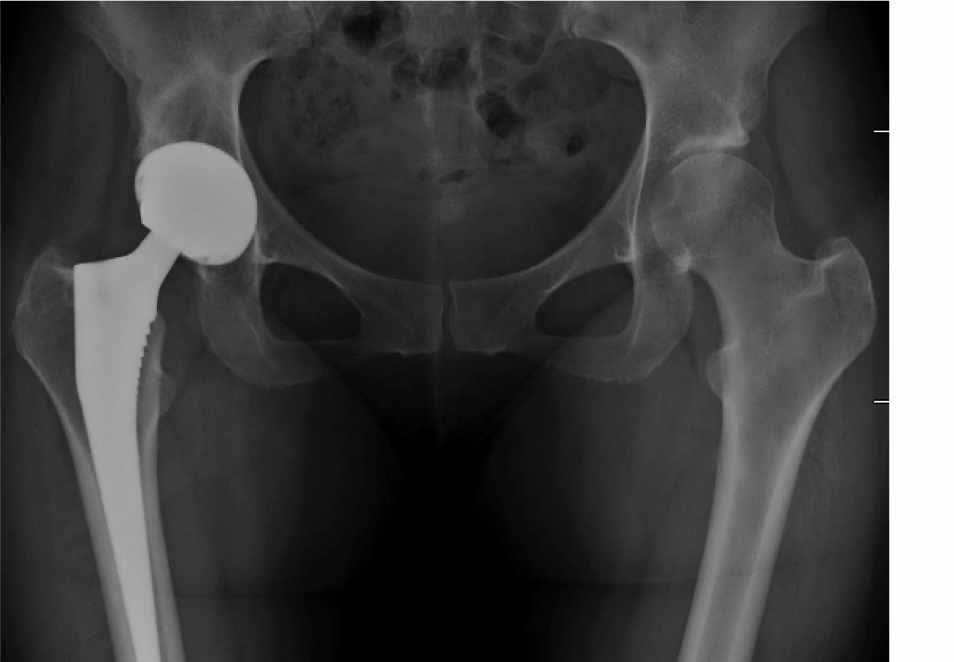
Following total hip replacement, the X-ray demonstrates the prosthesis in an appropriate position. Both the acetabular and femoral components are well aligned and securely fixed, restoring the normal anatomy of the hip joint. By replacing the damaged joint surfaces, the painful bone-on-bone contact is eliminated, helping relieve symptoms, improve mobility, and allow the patient to return to daily activities.
See also
Related topics
Hip osteoarthritis · knee
Symptoms, causes and when to consider joint replacement.
Orthopedic surgeon in Costa Rica
Training, hospitals and specialties of Dr. Aria Ravery.
Cost of joint replacement
What determines the cost and how to get a personalized estimate.
We’re here to help
Book an appointment
Hospital Internacional La Católica · +506 2246-3184 · WhatsApp +506 7127-5454
dr.ariaravery@gmail.com